Reports from Sahara Reporters suggests that there are fears over President Muhammadu Buhari’s health.
President Muhammdu Buhari
According to a source from the presidency, some of President Buhari’s aides are concerned about his health.
The aides are of the thought that the president’s frequent travels might be taking a toll on his wellbeing.
A sources informs that the president’s personal physician, Dr Suhayb
Sanusi Rafindadi, now stands very close to him during and after public
events on foreign and sometimes domestic trips.
It is also gathered that Buhari’s chief security officer, Abdulkarim
Dauda, travels two days ahead of the president in order to spend two
days in hotel rooms where Mr. Buhari is expected to sleep. “It is a precautionary measure,” said the source.
The president will be embarking on another whirlwind of global travel
beginning with trips to Addis Ababa, Ethiopia and Nairobi, Kenya before
the end of January.
Starting from February, President Buhari is scheduled to visit Paris,
London, Qatar and Saudi Arabia for official visits. Some of the trips
are also related to conferences.
Buhari’s trip to Saudi Arabia comes on the heels of the Nigerian
Army’s alleged massacre of Shiite Muslims and the arrest of Shiite
leader, Ibrahim El Zakzaky.
Meanwhile, in carrying out his domestic responsibilities, President
Buhari will be in Ogun state as from Febraury 1 to celebrate 40 years of
the state existence. The celebration is said not to be just for the
state’s birthday, but to harvest some completed projects across the
three senatorial districts.
Financial Times UK calls ‘Buharinomics’ the height of foolishness
Leading international business publication, The Financial Times UK
has described the economic policies of the Buhari administration as the
‘height of foolishness’.
Steve Johnson, Deputy editor of the FT’s EM Squared section wrote
Copying Venezuela’s
exchange rate policy and China’s failed equity market strategy might seen the height of foolishness.
The entire article is reproduced here:
Nigeria plans to create a $25 billion fund with public and private financing to modernize infrastructure and avoid a recession.
Copying Venezuela’s exchange rate policy and China’s failed equity market strategy might seem the height of foolishness.
But, at least in the opinion of John Ashbourne, Africa economist at
Capital Economics, that is precisely what Nigeria, the continent’s
largest economy, has just done.
“Low oil prices are battering Nigeria’s export-dependent economy, but
it’s the government’s market-distorting response that risks pushing the
country into a Venezuela-style crisis,” Mr Ashbourne says.
“Nigeria is sliding towards a Venezuela-style FX regime and adopting a
Chinese-style stock market circuit breaker. Neither will reassure
foreign investors, many of whom seem to be eyeing the exits.”
Both measures were announced after markets closed on Friday, January 15.
The circuit breaker on the Nigerian stock exchange, one of the worst
performing in the world this year with a fall of 17.7 per cent, will
pause trading for 30 minutes if stock prices fall 5 per cent. Trading
will cease for the day if it is triggered twice in a session, or after
1.45pm.
This month, Beijing abandoned a similar policy after just four days,
concluding that in a falling market the existence of the circuit breaker
encouraged more selling as traders rushed to exit while they could.
“The effect is akin to calling last orders at a crowded bar,” Mr
Ashbourne says. “It is hardly confidence-inspiring that Nigeria is
copying a Chinese policy that is widely seen to have failed.”
He accepts that Nigeria’s circuit breaker may not be as badly
designed as the Chinese version. Whereas the NSE All Share index rarely
falls by 5 per cent a day, the Shanghai Composite did so a dozen times
in 2015. The NSE’s version has not yet been called into action.
Nevertheless, Mr Ashbourne says that using a circuit breaker to shore
up the market, rather than to avoid volatility, is “deeply flawed”.
Simultaneously, the central bank has said it will stop selling US dollars into the interbank FX market.
Nigeria has operated a de facto twin currency system for the naira
since February 2015, when the bank held the official interbank rate at
N199 to the dollar to avoid a spike in inflation. The unofficial rate,
available at bureaux de change, has plunged to N300/$, as the first
chart shows.
However Mr Ashbourne argues the latest move takes Nigeria a step
along the road to a Venezuela-style scenario, where the dollar now buys
913 bolívars on the black market, according to dolartoday.com, compared
with an unofficial rate of 6.28/$.
“Suspending US dollar sales to the interbank market will force
consumers and firms to source dollars at bureaux de change,” he says,
while providing an implicit subsidy for companies and individuals with
the connections needed to access the official rate.
As the second chart shows, Nigeria’s reluctance to let the naira’s
official exchange rate weaken means it has borne the brunt of the sharp
fall in oil prices since the middle of 2014.
In naira terms, the oil price has fallen from $115 a barrel to around
$35, with the modicum of weakening permitted so far doing little to
take the edge off the fall in oil prices to $28 in dollar terms.
In contrast, Russia, which has allowed the rouble to fall sharply, is
still seeing oil prices of around $65 in local currency terms, with
many other oil exporters such as Brazil and Azerbaijan also seeing more
cushioning of the blow than Nigeria.
Charles Robertson, chief global economist at Renaissance Capital, who
drew up the second chart, expects Nigeria to bow to the seemingly
inevitable and devalue the naira, given that his calculation of fair
value is N305/$, very close to the current black market rate.
He notes that frontier market funds are now underweight Nigerian
equities, and believes that international investors “are likely to
remain on the sidelines,” barring an obvious catalyst for change.
Nevertheless he believes a devaluation to N250/$, “while no longer
sufficient to ease all dollar shortages … would be good enough to
warrant investors taking a fresh look at Nigeria, especially if they
expect a rebound in the oil price”.
Daniel Salter, global equity strategist at RenCap, has been busy
analysing just when equity market investors should consider returning to
a freshly devalued Nigeria, if history is anything to go by.
Mr Salter analysed 13 emerging market currency devaluations since
1994 in countries ranging from Mexico and Turkey to Egypt and South
Korea.
His conclusions are that it is rarely worth buying in anticipation of
a currency devaluation and that, on average, equity markets do not hit
their low point (in dollar terms) until 99 days after the start of the
currency devaluation.
This delay can vary significantly, though, as the final chart shows.
In the case of South Korea in 1997 the stock market troughed the day
before the won started to fall. In Nigeria itself, in 2009, this point
was reached after 35 days.
However in the cases of Thailand (1997), the Philippines (1998) and
Egypt (2001), it would have paid equity market investors to stay out for
at least six months.
Mr Salter believes the lag is due to two factors: the initial
devaluation is often insufficient to stabilise the currency; and that
devaluations frequently coincide with banking crises.
Unfortunately, this analysis probably tells us little about how
Nigeria’s equity market is likely to behave in the year after any
devaluation.
In the 13 previous episodes, the stock market typically fell 3 per
cent in dollar terms in the three months after the start of the
devaluation. However, as the above chart shows, there has been huge
variability in this figure, from -56 per cent in Mexico in 1994-1995 to
+100 per cent in South Korea in 1997-98.
Likewise, on average the typical stock market gained 4 per cent in
dollar terms in the year after the devaluation, but once again this is
the average of a widely dispersed data set, with the returns ranging
from -86 per cent (Indonesia, 1997-98) to +172 per cent (South Korea).
The sector breakdown perhaps delivers a clearer message. RenCap found
that consumer staples stocks have tended to outperform in the 12 months
after the start of a devaluation, while consumer discretionary
companies and industrials tend to pick up once the currency has
bottomed.
Financial stocks, in contrast, tend to be the worst sector in the
year after a devaluation, probably due to declining credit quality.
Breaking News: Dr Ikpeazu just lost his appeal at the Supreme Court Now !
OKEZIE Ikpeazu just lost his appeal against his case of tax forgery at the Supreme Court now.
He had filed a preliminary objection at the Federal High Court where’re he lost and from there to the Court of Appeal and eventually just lost at the Supreme Court now.
If you recall ,Chief Friday Nwosu, an Abia chieftain of the People’s
Democratic Party (PDP) instituted a case of tax forgery against the
party gubernatorial candidate of the
party for the April 11 governorship election, Dr. Okezie Ikpeazu
THE hitherto bobbling town of Ubulu-Uku in Aniocha South Local
Government Area of Delta State, has been thrown into mourning, following
the killing of their king, HRM Obi Akaeze Edward Ofulue III by his
abductors. IGP-Solomon-Arase
The deceased monarch whose decomposing body was found at Ekpon bush
in Edo State, was reportedly kidnapped by suspected Fulani herdsmen on the 5th of this month at a bad spot along Obior/Igbodo Road.
As at about 12 noon when Saturday Vanguard visited the community,
armed soldiers were stationed at the Ogwash-Uku Road end of the town to
forestall the breakdown of law and order, whereas youths of the area
barricaded the Issele-Uku Road end with woods and bonfire.
The youths in their numbers, took advantage of the situation to make
brisk business by extorting money from motorists and ‘okada’ riders
before they were allowed access into the community.
Our correspondent who drove round the community, report that the news
of the unexpected death of the 52-year-old monarch who was crowned in
December, 2006 crippled economic activities in the town, adding that all
shops in the area were closed.
All attempts to get the people’s reaction did not yield result as
they declined comments on common ground, saying; “Saturday Vanguard, we
are not in the mood to talk now; this is not the best of time for our
kingdom.
“As you can see, everybody is mourning, including children. These
Flani herdsmen have dealt with us. We have not been ourselves since we
got the news of death of our revered king”.
Meanwhile, one of the vigilante members in Ubulu-Uku told Saturday
Vanguard that the decomposing body of the king was found at Umunede bush
in Ika North East Local Government Area of Delta State and not Ekpon in
Edo State.
The vigilante member, who pleaded anonymity, said they discovered two
decomposing corpses in the bush but were able to identify the monarch
“because of his beads and clothes,”.
The source who was cornered by our correspondent in the community,
said: “We could not identify the second body but the fellow had Hausa
shoes on. This is a very challenging period for us in this kingdom. “I
was one of those who went in search of the king.
In similar development, the Police Public Relations Officer, PPRO in
the state, Celestina Kalu said the decomposing body of the monarch and
one other unidentified corpse were recovered in a bush within Umunede at
the boundary between Delta and Edo states.
Recalls how his father died and reveals why their movies are full of rituals
Nollywood star actor and comedian,John Okafor,popularly known as,Mr.
Ibu, in this interview expresses his reservations on the efficacy of the
current anti-corruption war even as he revealed that Enugu State has
abundant latent Nollywood potentials yet untapped.
BY FRANCIS IGATA What do you foresee for the Nollywood industry in 2016?
The picture I foresee for the Actors Guild of Nigeria,AGN,in 2016 is
big. But,there is a clause. The clause there is that we should
stop attacking each other. If we stop attacking each other by going
to court and police every minute including washing our dirty leaning in
the public, we will go far. AGN is one all over the world. Our own
should not be an exception. Good administration has eluded us for so
long now. We do not have people that can pilot the affairs of the AGN.
We are fighting every minute. How do we succeed in life in that kind
of atmosphere? Now,I sent a proposal for Film Village to the Federal
Government. Only God in Haven knows weather it has gotten to the
designated point or not. The same thing was sent in to the government of
Enugu State. We are conducting a poll to ascertain where will be most
suitable for citing a Film Village. Enugu State scored 83%. It means
that if ever we are going to have a film village, Enugu State is the
most suitable nationwide. Second to Enugu is Lagos, with 53% then
Owerri, Asaba, 38%,34% respectively. That is why if you watch most
Nollywood films,t here locations are shot in Enugu. John Okafor (Mr. Ibu)
So we have more advantage than any other place. We are looking
forward to having that film village in Enugu. It is very important. Let
government make us responsible rather than looking beggarly,going to
government houses and so on. I promised myself that I will never be part
of the people going to government houses seeking alms. Our people
should stop piling themselves in government houses. When ex-President
Goodluck Jonathan was in office,every minute they were there asking for
all maner of favour. And the ex-President loved us so much that he gave
them huge money. All those who diverted monies meant for AGN or Movie
Makers will die because they do not know the souls they have killed. For
2016,if all these things are taken care of, AGN will do better. I am
promising one thing, am not contesting anything on the AGN but, I have a
lot of surprises.
Now that you said Enugu State ranks highest for citing of the Film Village, have you taken your proposal to the government?
A woman working with me has sent in the proposal. The federal or state
government might not spend much because we will go ahead and get
sponsors. They will come and build a five-star hotel with a big gate
carrying a neon sign,AGN. All the things one may need from all
accredited members of AGN will be there. We will be resident inside the
village. People will come in,shoot pictures,shoot musicals among others.
I have all these things inside. I equally have friend who are not
Nigerians willing to come and invest.
What is your perception of the President Muhammad Buhari-led government anti-corruption war?
It is too early to fight this. I would have preferred the government to
set their house in order first. Set the administration going,make the
people who voted you talk good of you as you are coming in. The corrupt
people know themselves. While your good work is going on,you can then
start picking them one after the other. Whoever that has offended
government knows he or she has done so.
Government should set its house in order first. Let the good things
about this administration flow first before the arrests. Let Nigerians
talk good of you first, then you can now tell them,there are people who
did this and that,that need questioning. But starting with this
quarrel,fighting as a new government,I do not think it will help. Many
people are talking about hunger,no money,collapsed businesses among
others. They would have first of all laid good foundation about their
administration so that people will feel them first. The change should be
seen in the peoples’ welfare and every other thing will follow. That’s
my own idea. Why is it that most Nollywood films tilt towards,ritual and affluence that are perceived as lacking morals?
Films are a reflection of the society. Nobody believes he is a poor
person in Nigeria. We are trying to give proper interpretation of what
is happening in the society. Films give back the life in the society.
But,already,we have held a meeting that all things should go and give
way for films dwelling on family,tragic,comedy stories. The issue is
that the ritual thing can’t even go in the society. My father for
instance, was poisoned to death by his best friend. I was small then.
When my father died,he told my mother in a dream about three weeks
after, that it was his best friend that killed him. In that dream,my
father told my mother,invite the man who killed me but nobody should
hurt him.
My father equally instructed my mum to invite my brothers and
relations inside our compound. Tell them what I said. My mother invited
the man, as my father instructed and other relatives. My fathers
instruction was done exactly as it came. They told the man what my
father said. He denied and they said okay,you will eat the yam roasted
on my father’s grave. If you did not do it,you will go home, but if you
did it,you will die here. The yam was roasted on my father’s grave in
the presence of the man. All the elders in my village ate the yam and
said the yam was sweat and that we did not put poison in the food
roasted on father’s grave. Then came the turn of the man. The elders
asked him to say that if he was responsible for the death of my
father,Emmanuel Okafor,let this food be the last food he will eat.
But if he did not know anything about my father’s death,let his life
span be increased. The man who killed my father refused to eat it. And
remember,my father had warned us in the dream,that we should not touch
him. When he refused,nobody touched him and he left. That is to tell you
that the rituals we are shooting is real. But the new generations
coming up,they are oblivious about these concoctions. That is why we
shoot films to highlight these things so that people will know and shun
such evil ways.
What happened to the money,ex-President Jonathan allegedly gave to the AGN as loan?
Laughter…I did not see one naira oohhhh! I do not know who processed
andcollected it. If the money was released,I do not know. If they did
not release it,I do not know. The people who were supposed to give us
information, talking about the leadership of AGN, did not tell us
anything even the first $200 million,nothing was heard of it. What am
looking for is hectares of land for the Film Village,then I will leave
acting.
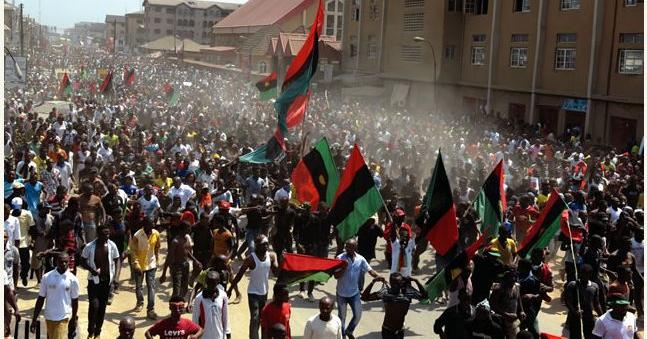
Biafra: Eleven Deaths Due To Police Violence Against Protesters – German Tabloid.
The Society for Threatened Peoples (STP) reports that eleven
Biafrans have lost their lives in a bloody crackdown on protesters in
southeastern Nigeria since Sunday. The human rights organization now
demands the establishment of an investigative commission to clarify the
extent and the backgrounds of the violence. “The security forces must be
held accountable for the excessive use of
force in the crackdown. This is the only way to prevent a further
escalation,” said Ulrich Delius, the STP’s Africa-expert, in Göttingen
on Wednesday. The human rights organization sharply criticized the
behavior of the security forces, who are denying the fact that several
Biafrans got killed during the protests – despite contrary reports from
doctors and eyewitnesses. Since December 2, 2015, a total number of 26
Biafrans lost their lives in the demonstrations against the illegal
detention of Nnamdi Kanu, the former Director of Radio Biafra.
Last Sunday, eight supporters of the organization “Indigenous People
of Biafra (IPOB)” got killed in Aba (a city with 1.7 million inhabitants
in the state of Abia) when, despite a demonstration ban, they publicly
demanded Kanu to be released. There were also protests in the cities
Asaba and Engu (both in Delta State). Here, 30 Biafrans were injured and
26 were arrested in the crackdowns.
On Monday, three protesters got killed in the city of Aba when
soldiers opened fire on a demonstration. Once again, the police denied
responsibility for any injuries or deaths, stating they only used
teargas.
“The ruthless and disproportionate actions of the security forces are
obviously stoking further tensions and violence in the south-east of the
country,” warned Delius. Rather than trying to de-escalate, Nigeria’s
security agencies rely on confrontation and on demonstrations of power.
This leads to even more tensions, as the protesters are growing more and
more resentful over the arbitrariness of the authorities, who are
keeping Nnamdi Kanu locked up although a court had decided that he
should be released. Originally, Kanu was supposed to be heard at the
Supreme Court in Abuja on Sunday, but the trial was postponed to January
21 because the judge did not turn up.
A Federal High Court in Abuja has adjourned the case
concerning the former National Security Adviser (NSA), Col Sambo Dasuki
(rtd) till February 4.
Dasuki in court today. Photo credit: Stephanie Findlay
Judge over the case Hussein Yusuf said the
adjournment will allow the court time to go through all submissions made by the counsels.
At the hearing, the prosecuting counsel, Rotimi Jacobs had
prayed the court not to entertain an application by the defendants to
stop the trial.
“I’m not unmindful that the first defendant filed an
application urging your lordship to prohibit the prosecution to proceed
with this charge or stay the proceedings,” Jacobs said.
He said he submits that the application cannot be taken or if taken should be adjourned till the end of this proceeding.
“My Lord, the era of stopping criminal trial is over by the effect of the criminal Justices Act in May 2015.”
Jacobs said once an arraignment has been made, trial continues day to day.
“My lord that is the provision of Section 396 and with due respect the provision the trial should continue,” he said.
He also added that section 306 enjoins the court not to stay the application.
In his defense, Joseph Daudu told the court that the
prosecution took his client back into custody shortly after he was
released.
“As far as we are concerned it is our duty to ensure that the orders of this court are obeyed,” Daudu said.
He also noted that his team is not aware of where the brought his client, Dasuki from.
The only thing I can see now is that he is looking thinner and thinner and we have not even discussed with him,” he said.
He also reminded the court that it was on the judge’s order that the federal government produced Dasuki on Thursday, January 21.
“First of all, a lot of damage has been done by the fact that he was re-arrested,” he said.
He said: “Nobody forced them to bring him to court when they had not finished their investigation.”
He also informed the court that the defendants have been
charged with a 26-paragraph counter affidavit this morning and will need
time to reply.
Also speaking, counsel to the second defendant, Akin Olujimi said his team has been served additional proof of evidence.
He asked that the prosecution be advised to place all his cards on the table if he is sure he is ready to go on with trial.
“My lord we have to cross all these hurdles created by the prosecution before we can head to trial,” Olujimi said.
Speaking also, counsel to the fourth defendant, Solomon Umoh said he is aware of an application before the court.
He however, noted that his team is yet to be served the application.
“My lord I can say the issue is not yet ripe, I am yet
to get the said application and when that comes I will have yo study
it,” Umoh said.
But Jacobs in his argument told the court that it was only
this week that one of the counsel informed him that he needed the
statements of accused persons and some other documents.
He said it will be unfair to state that he created a hurdle for the defense counsels.
He added that the address on provided by the counsel was
not complete thus delaying the serving of the application and counter
affidavit.
Having listened to all the submissions, the judge adjourned the case to Thursday, February 4.
Dasuki alongside his former finance director, Shuaibu
Salisu, Baba Kusa and two companies are facing a 19-count charge
bordering on money laundering and criminal abuse of public trust before
Justice Yusuf.
He also facing various charges in two different courts in Abuja.
He is accused of diverting funds meant for the procurement of arms during his tenure as the national security adviser.
The money, $2.1 billion, the EFCC alleged were shared
between the former NSA’S cronies for the funding of the last
presidential election campaign.
Meanwhile, Dasuki has filed a suit against the federal government before the ECOWAS court in Abuja over his continued detention.
In the suit filed by his lawyer, Robert Emukpoeruo, Dasuki wants the
court to declare among other things that his continued detention after
having been granted bail by three different courts and met the
conditions for his release, was “unlawful, arbitrary and an egregious violation” of his human rights.